

Kurdistan Regional Government
Representation in Italy
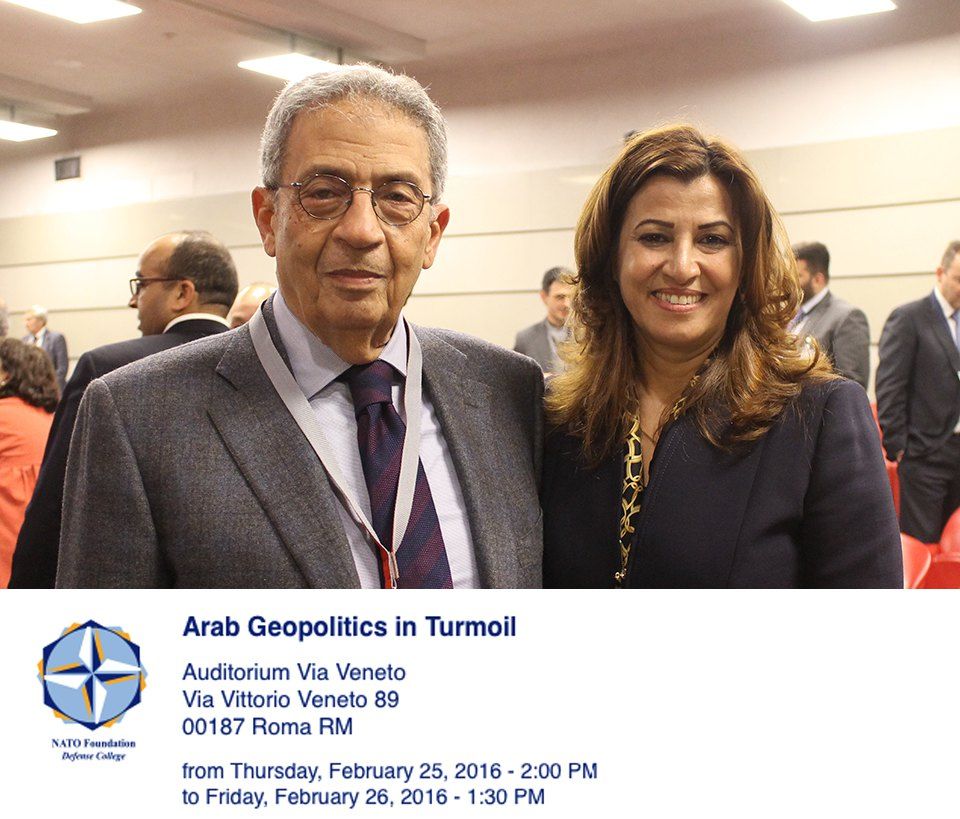
Dr. Kader took part in the international conference on “Arab Geopolitics in Turmoil,” organized by the NATO Defense College Foundation in cooperation with the Gulf Research Center Foundation, the NATO Science for Peace and Security Programme, the NATO Defense College, and the University of Jordan, held at the Auditorium on Via Veneto in Rome on February 26 and 27.
The conference, which was introduced by Alessandro Minuto-Rizzo, President of the NATO Defense College Foundation, and Janusz Bojarski, Commander of the NATO Defense College, was attended by representatives of the Italian and foreign diplomatic, political, military, and academic worlds, particularly from Arab countries, such as the former Secretary General of the League of Arab States, HE Amre M. Moussa; the former Prime Minister of Libya, Mr. Mahmoud Gebril; the former Egyptian Ambassador to NATO and the EU, Amb. Mahmoud Karem; the Deputy Prime Minister of Yemen, Rashad Al Alimi; and the President of the National Security Bureau in Kuwait City, Sheikh Thamer Ali Al-Sabah.
The Middle East is facing several challenges: regional divisions, civil wars, the rise of terrorist groups and other non-state actors, and humanitarian crises. These challenges are rooted in ethno-religious issues and a struggle for control of resources. After Lebanon, other countries in the Middle East are now at risk of disintegration due to ISIS terrorists and other centrifugal forces. The exclusive use of military means has proven, both in the past and today, not to be the ideal tool for resolving these types of conflicts, which require effective political cooperation within the international community to develop a shared vision for ensuring stability and security in the region and to work intensively on the educational and cultural systems within the Arab world.
Following the remarks of Mustafa Alani, Director of the Department of Terrorism and National Security Studies at the Gulf Research Center in Jeddah, who spoke about all the forces fighting Daesh and the threat it poses, Dr. Kader took the floor, pointing out that Dr. Mustafa had forgotten to mention the Kurdish Peshmerga forces, who have been the only ones on the ground fighting Daesh for the past two years across 1,050 square kilometers and who have made themselves available to both the Iraqi and Syrian governments for the liberation of territories outside their territorial jurisdiction. In this situation, the central government in Baghdad not only fails to support the Kurdistan Regional Government militarily, but has also failed to provide the budget envisaged by the Iraqi Constitution for nearly two years. Despite these difficulties, the Kurdistan Region is hosting 1.8 million refugees and displaced persons, regardless of ethnic or religious affiliation.