

Kurdistan Regional Government
Representation in Italy
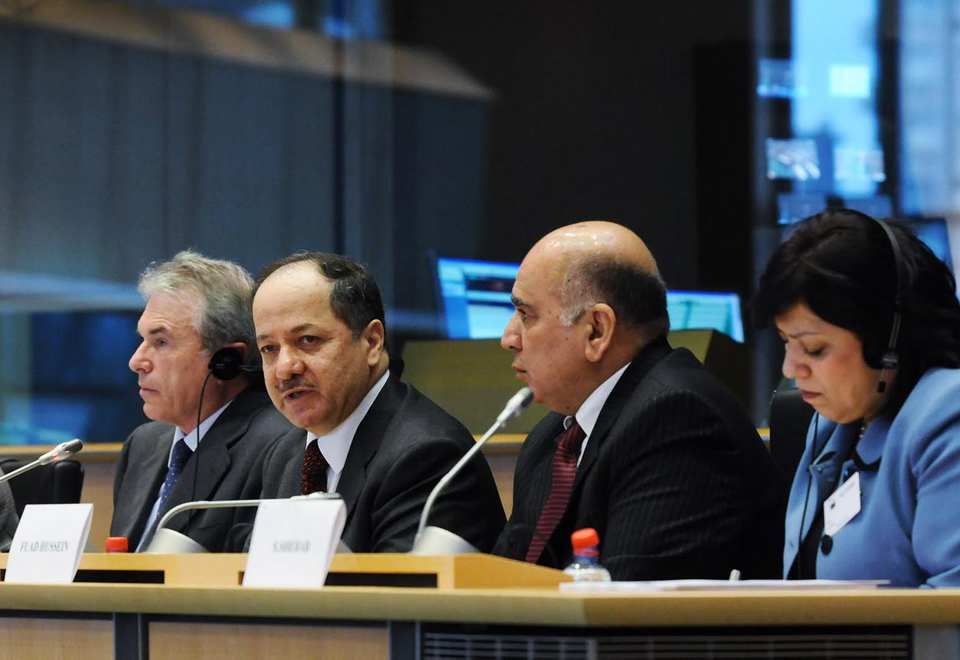
Brussels, Belgium (KRP.org) – Kurdistan Region President Masoud Barzani today attended a special meeting of the European Union Parliament's Foreign Affairs Committee in Brussels. During the event, which was attended by a large number of MEPs, the President spoke about recent political and security progress in Iraq, Kurdistan, and the wider region.
He called on the EU Parliament to show solidarity with the people of Kurdistan and to assist them in recognizing the crimes against the Kurdistan people in Iraq as genocide. He said, "We would be pleased if you could show solidarity with the rights of the Kurdistan people. We also invite you to make every effort to recognize the genocide against our people." The President attributed the relative stability and security in Kurdistan to the policy of tolerance and peaceful coexistence among the various religious and ethnic communities in Kurdistan.
“In the aftermath of the March 1991 uprising in Iraqi Kurdistan, we certainly do not seek revenge against the people who oppressed us. Once again, after the fall of the regime in 2003, we did not seek revenge on anyone. We opened a new chapter with our people and with others, and this greatly helped us focus our efforts on rebuilding our country and alleviating the pain and suffering of our people. As a result of this policy, the Kurdistan Region enjoys a high degree of security and stability,” the President said.
Following the speech, a number of MEPs asked the President questions, all of whom applauded the significant progress made by Kurdistan in the areas of security, stability, and economic development. They particularly praised President Barzani's leadership and the KRG for their generous policy of hosting large numbers of refugees and for the religious tolerance that prevails in Kurdistan.
Full text of the President's speech:
First, I would like to thank the European Parliament's Foreign Affairs Committee for inviting us here today. There is no doubt that the EU plays an extremely important role, and there is considerable potential for collaboration in many areas between the EU and the Iraqi Federal Government, as well as with the KRG, particularly in the fields of economics and trade. As you know, there is an agreement between the EU and the Iraqi Federal Government; we hope that the KRG can play a role within this agreement, bringing the EU and our country closer together, and the EU Parliament and the Kurdistan Region closer together. Today, I would like to briefly address the tragic situation of the Kurdistan people. They have suffered as a result of a series of hostile campaigns aimed against them in Iraq. We were victims of chemical weapons and the infamous Anfal campaign, in which 182,000 people disappeared. We managed to recover the remains of approximately 4,000 of them from mass graves in the deserts of southern Iraq. The search continues for the remaining victims. In the chemical attack in Halabja, 5,000 innocent civilians, mostly women and children, were killed by chemical gas in the space of a few minutes.
Ladies and Gentlemen,
In the Kurdistan Region, we have adopted a policy of tolerance, peaceful coexistence, and acceptance of others. In the aftermath of the March 1991 uprising in Iraqi Kurdistan, we certainly did not seek revenge against the people who oppressed us. Once again, after the fall of the regime in 2003, we did not seek revenge against anyone. We have opened a new chapter with our people and with others, and this has greatly helped us focus our efforts on rebuilding our country and alleviating the pain and suffering of our people. As a result of this policy, the Kurdistan Region enjoys a high degree of security and stability.
This has also helped many international companies from various countries come to invest in Kurdistan. A simple example: before 2003, per capita income in Kurdistan was less than $500; now it's over $5,000. We are at the beginning of the journey towards building democratic institutions, and we need your help and expertise to build these institutions. We would like you to show solidarity with the rights of the Kurdistan people. We also ask that you focus all your efforts on recognizing the genocide against our people. We would also like to work with interested parties to establish an EU representative office in the Kurdistan Region, which would help strengthen economic ties between Kurdistan and EU countries.
We would also like to invite you to support the political process in Iraq based on the Iraqi constitution, democracy, and federalism, and in the fight against terrorism. Unfortunately, terrorism has become a dangerous phenomenon affecting all peoples of the world. We ourselves have suffered greatly from terrorism, but we are steadfast in our fight against it, as there is no other way to address it.
We have adopted a policy of tolerance and religious freedom. Women in Kurdistan play their role in building our society and institutions. We are currently hosting 250,000 Syrian refugees, primarily Kurds, but also Arabs and Christians among them. We are also hosting 200,000 Iraqi Arabs from the center and south of the country who fled to Kurdistan from the threat of terrorism and in search of safety. There are now 10,000 Christian families who have fled from other parts of Iraq as well. Additionally, approximately 15,000 people from Anbar province have fled to Kurdistan.
We are proud that Kurdistan has become a haven for so many people. However, I must emphasize that the international community's assistance to these refugees has not been comparable to the assistance provided to refugees in other countries in the region. As a factor of stability, we will continue our policy in the Kurdistan Region and do everything possible with other Iraqi groups to resolve our problems and build state institutions. We reaffirm our commitment to the Iraqi constitution. Once again, I would like to ask you for your support and assistance. Thank you very much.